
Note: The 4 channel lightLINK must be connected to a LINKS Hub in order to power on and function. Additionally, there must also be a canopyLINK registered to the associated LINKS Hub with a climaLINK sensor connected in order for the high temperature lighting failsafe and no data lighting failsafe to function on the 4 channel lightLINK.
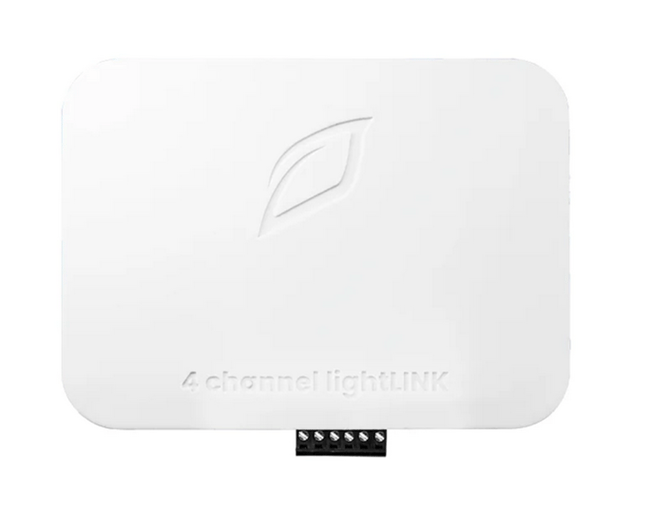
4 channel lightLink Technical Specifications
|
Input Power |
24VDC @ 1.5A Max. |
|
Analog Outputs |
(4) VDC: 0-10V 125mA Max/Output |
|
Terminal Wire Gauge |
26 - 16 AWG |
|
Tightening Torque |
0.3-0.4 Nm |
|
Dimensions |
4.813"W x 3.5"H x 1.375"D (122mm x 90mm x 35mm) |
Features
- 4 Independent 0-10V Outputs: Control up to 50 fixtures per channel, offering scalable lighting control across multiple zones.
- Flexible Analog Dimming: Enables smooth dimming for each zone, helping cultivators manage light intensity and energy use efficiently.
- Rugged, Reliable Design: Built for consistent performance, even in demanding environments, with optional DIN rail mounting for easy installation.
What’s Included
x1 4 channel lightLINK
x1 AC/DC Power Supply
x1 Mounting Kit
x1 10 ft. RJ-45 Cable
x1 Mini Screwdriver
4 channel lightLINK Dimensions
Size: 4.813" (122mm) W
3.5" (90mm) H
1.375" (35mm) D
Installation & Wiring Instructions
The 4 channel lightLINK modules are designed for mounting in electrical control cabinets and should be enclosed due to the exposed terminal design. If DIN rail is not available, brackets include mounting holes for surface mounting.
The 4 channel lightLINK connects Growlink’s intelligent controllers to 0-10V devices in
your growing environment.
The 4 channel lightLINK is intended for:
• 0-10V control of light dimming
• 0-10V Fan speed control
• 0-10V Variable Speed/Frequency Drives (VSD, VFD)
• Miscellaneous 0-10V control requirements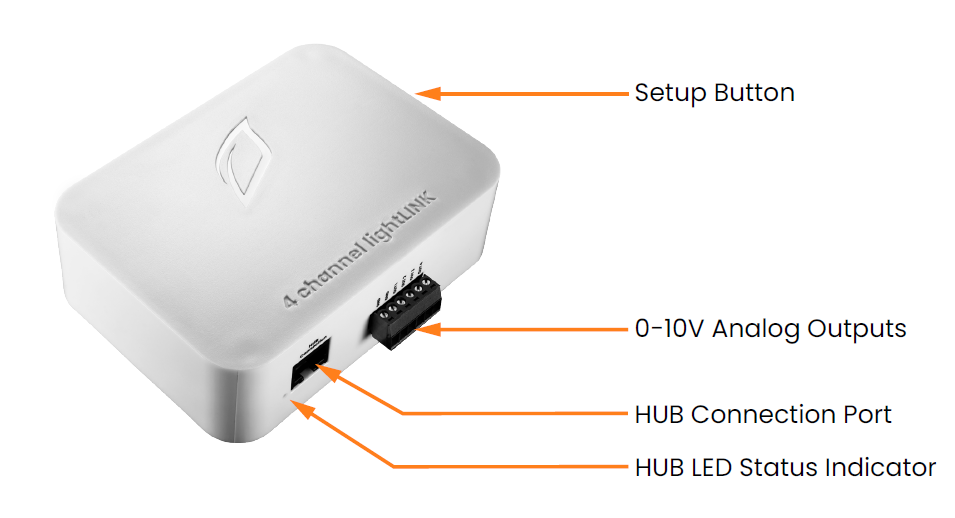
Setup Button: Readdresses the 4 channel lightLINK module.
0-10V Analog Outputs: Drives 0–10V-controlled equipment.
HUB Connection Port: RJ-45 connector port for power & data.
HUB LED Status Indicator: Indicates device power and HUB communication status.
4 channel lightLINK Outputs, 0-10V (Analog Voltage)
The 4 channel lightLINK features four (4) analog 0–10VDC outputs for controlling ballast
dimming signals, variable speed drives, and other devices with an analog voltage
control input.
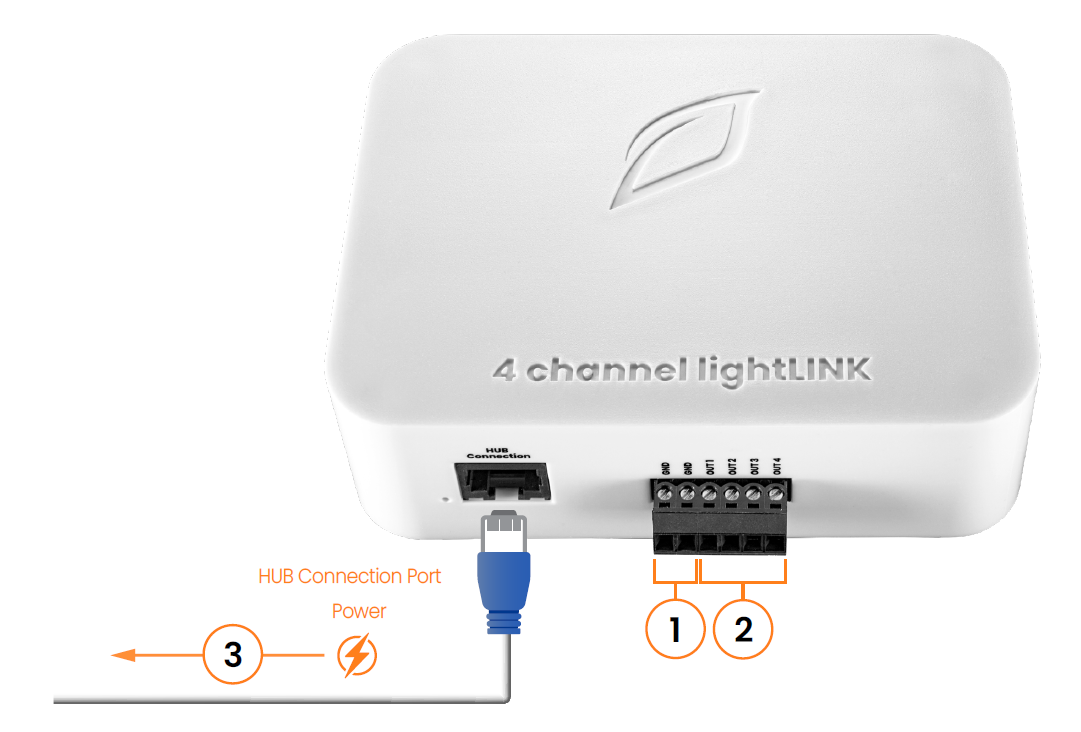
1. GND: Common DC ground terminals for connections.
2. Analog Outputs: (Out 1-4) Sinking/Sourcing DC outputs for driving lighting dimming
controls and other equipment with a 0-10VDC analog input. Each channel is capable
of driving up to 50 light fixtures (125mA max. per channel).
3. Power: Power is provided to the module via the HUB Connection Port.
1. Dimmable Ballasts & VFD Motor Controllers
Ballasts and VFD controllers that accept a 0-10V signal may be controlled by one
of four (4) analog voltage output channels. Each of the four channels may be set
to 0-10VDC independently. Internal feedback sensing manages voltage levels
automatically accounting for unit loading.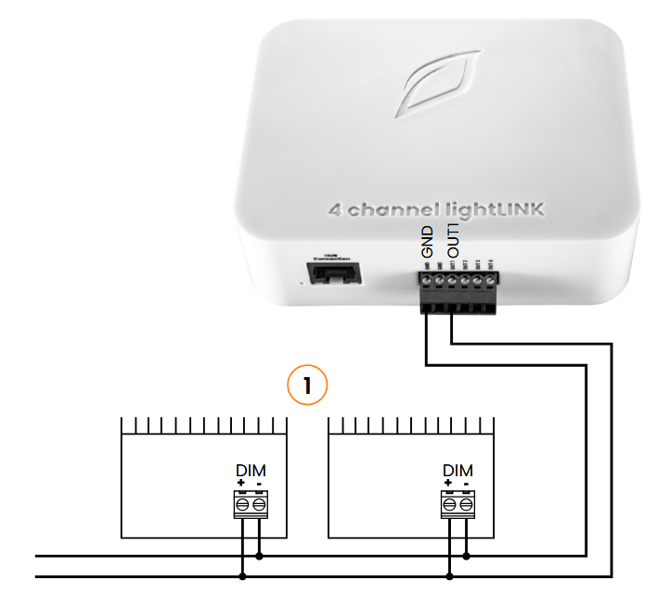
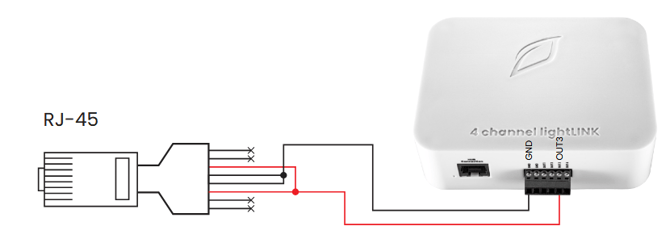
4 channel lightLINK, Outputs, RJ-45 (Gavita®)
Gavita® fixtures use a RJ-45 connector. The connections from a standard RJ-45 connector to the 4 channel lightLINK are detailed below. Example shows connection to Output Channel #3.
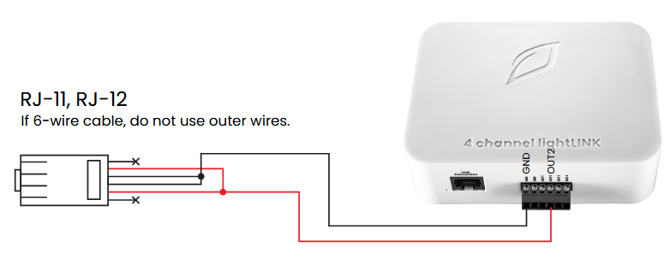
4 channel lIghtLINK Outputs 0-10V, RJ-12
Gavita®, Grower’s Choice®, Luxx Lighting®, and many other 0-10V dimmable fixtures use RJ-12 or similar style “phone” cord modular connectors. The connections from a standard RJ-12 style connector to the 4 channel lightLINK are detailed below. Example shows connection to Output Channel #2.
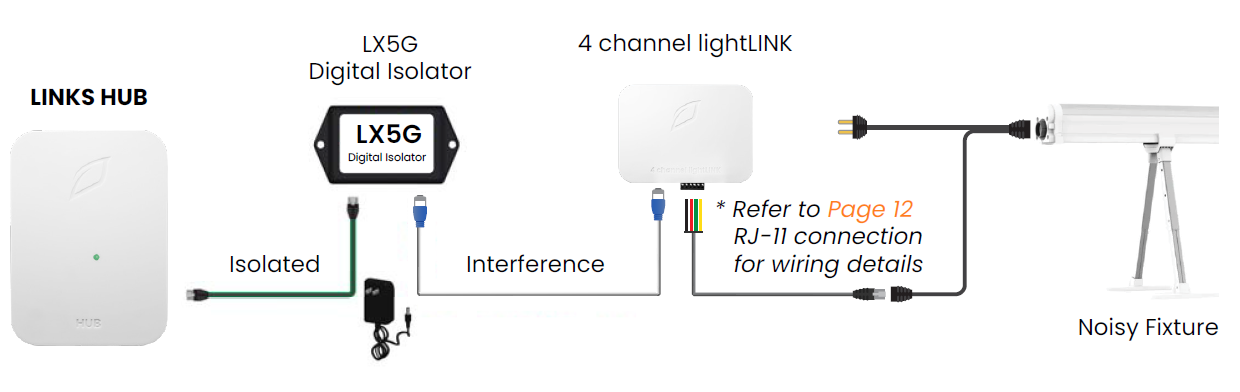
Faven®
Faven® brand fixtures use a floating power supply design that transmits low-voltage
communication over the 120–277VAC power line. This can introduce electrical noise
that feeds back into the control system, potentially disrupting communication.
To mitigate this, install an LX5G noise isolation device, which effectively blocks
interference and helps maintain stable system performance.
Note: If you don’t see a component in the wiring diagram that matches your brand of light, contact the manufacturer.
More detailed Installation instructions can be found by referencing the following manual:
4ch lightLINK Instruction Manual
Mobile App Setup Guide
1) Plug in your Growlink device to power it on. The LED should be blinking blue. If not, hold the SETUP button until status light flashes blue rapidly (12-15 seconds).
2) Download the Growlink app from the Apple App Store, or Google Play Store:
3) Go to portal2.growlink.com/signup or tap the ‘Sign Up’ button at the login page of the Growlink Mobile App to create a Growlink Account: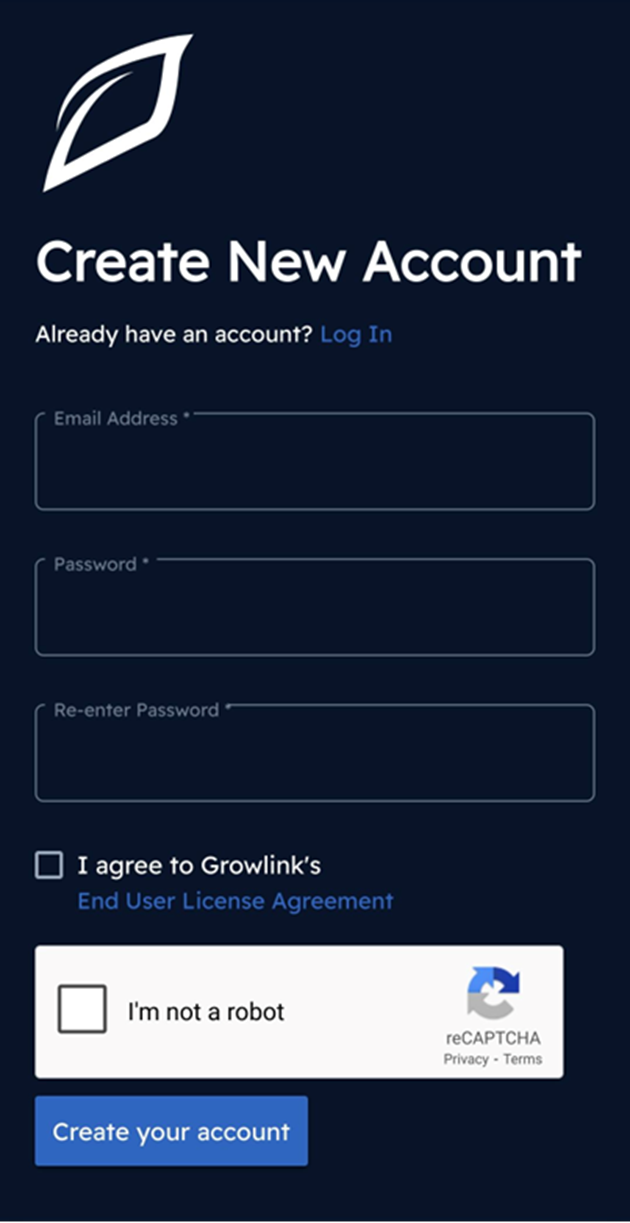
After creating your account, a verification email will be sent from ‘no-reply@growlink.com’ to the email address set for your newly created account. One must verify your email address in order to utilize your newly created account.
4) Open the Growlink Mobile App and login to your newly created and verified account: 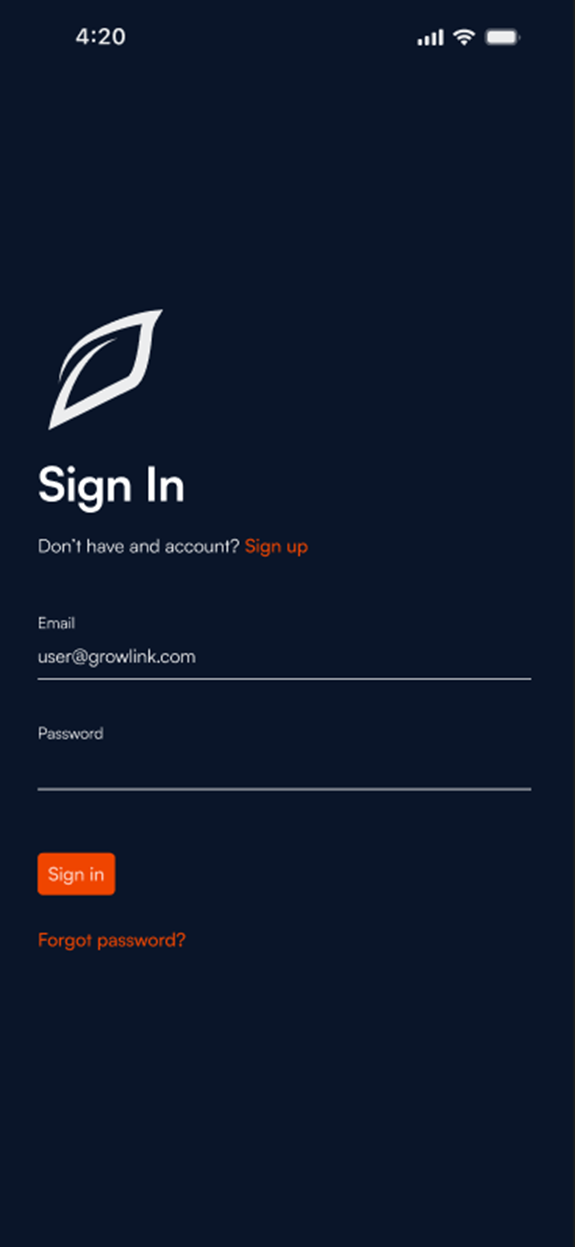
5) Tap the icon of three lines in the top-left of the Mobile App, then tap the Hardware button in the following menu: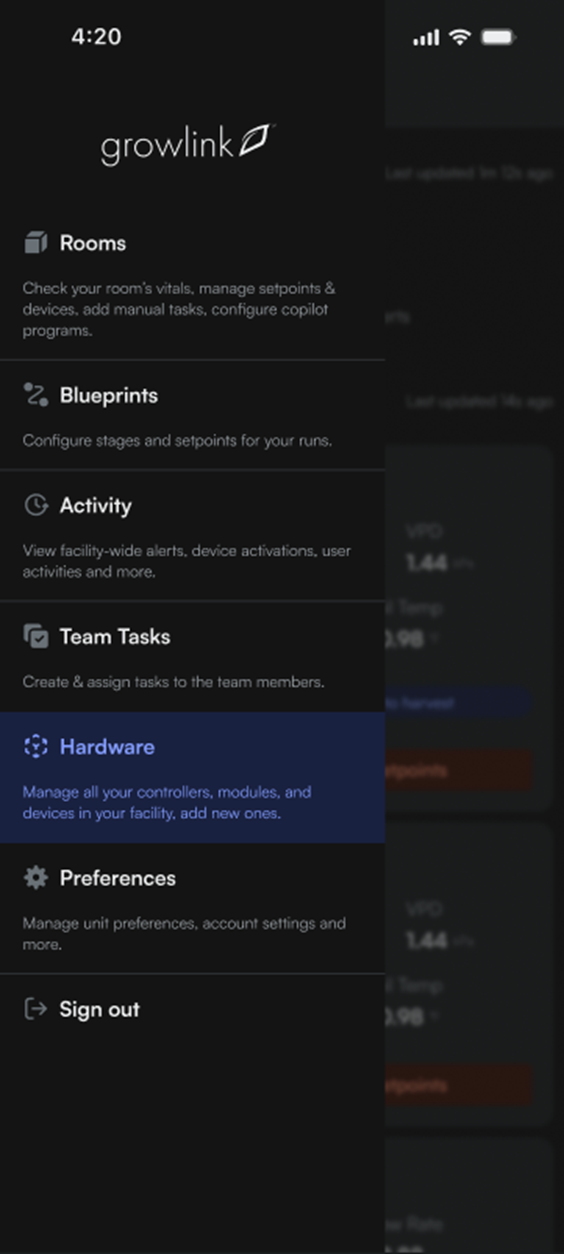
6) One can add a controller to an existing room, or tap the ‘+Add’ button in the following page to add a new room to your account. This is the container that will hold the future controller registration.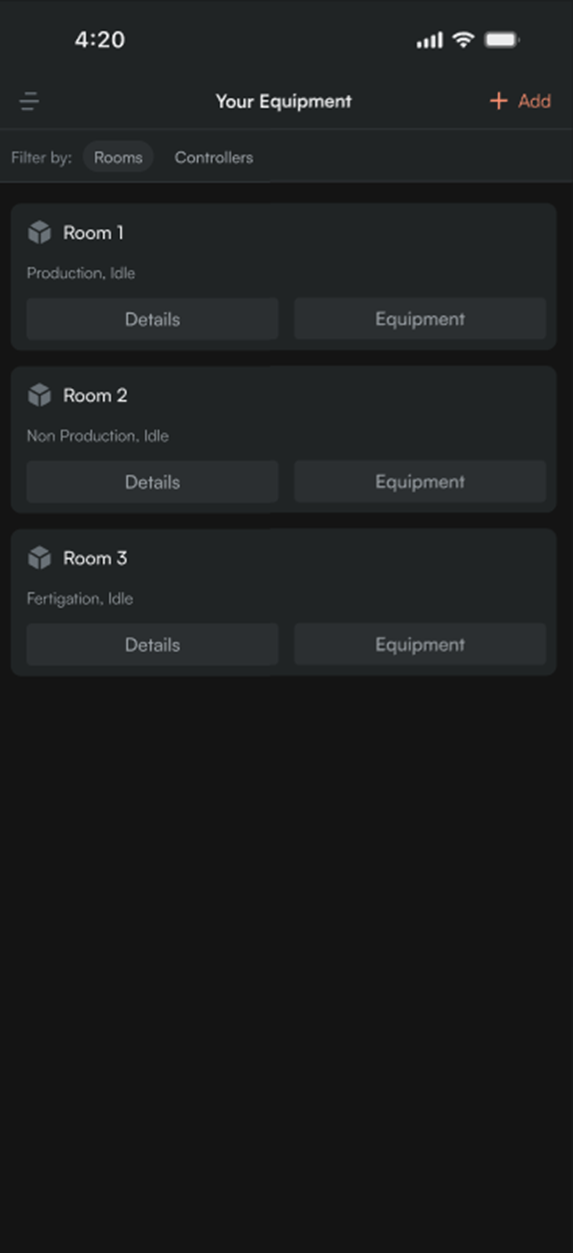
7) If you are creating a new Room, provide a name for the Room, the Square Footage of the Room, and the Room Type, followed by tapping the 'Create’ Button to finish creating that room: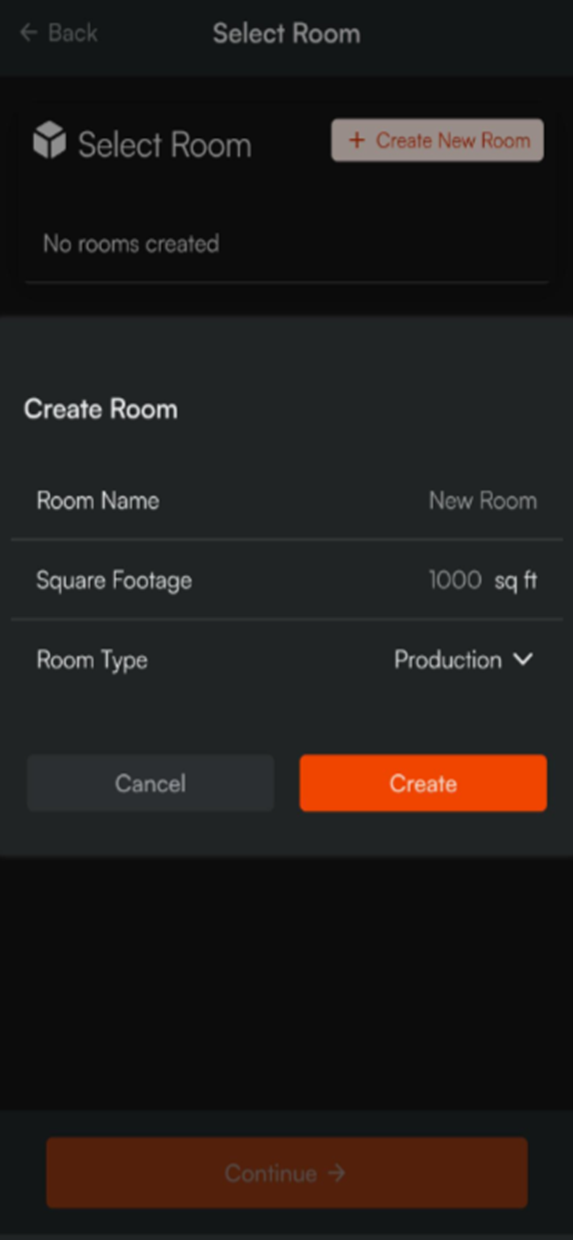
8) Once an existing room has been selected or a new room has been created, tap the ‘Continue’ button to begin registering the controller to your account: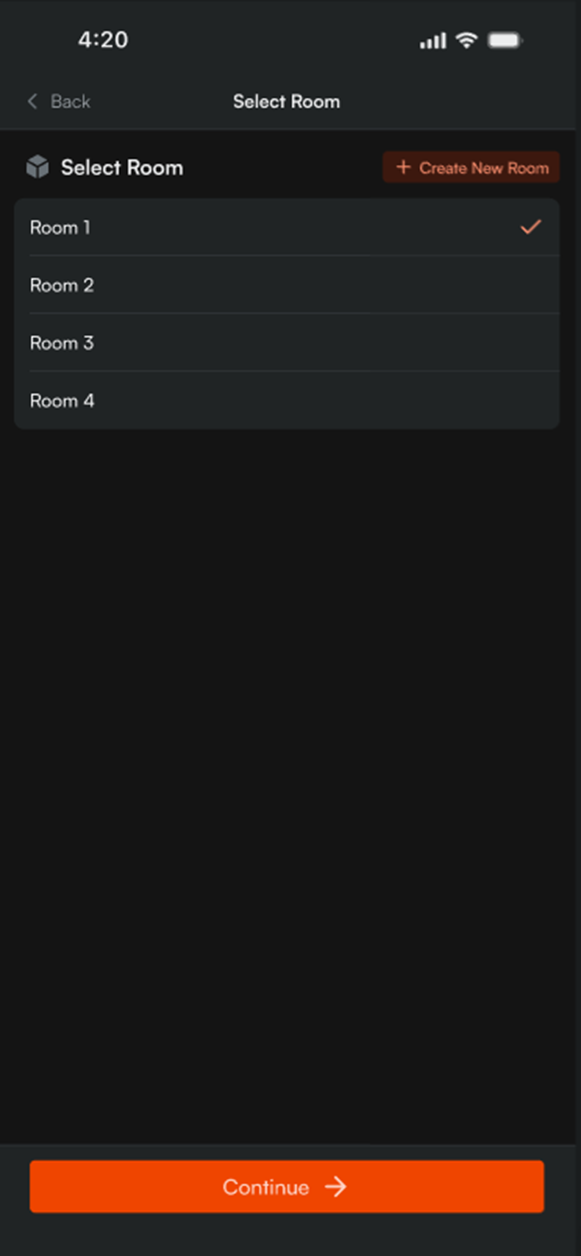
9) Within the Add Hardware Wizard, tap the LINKS button in the following page.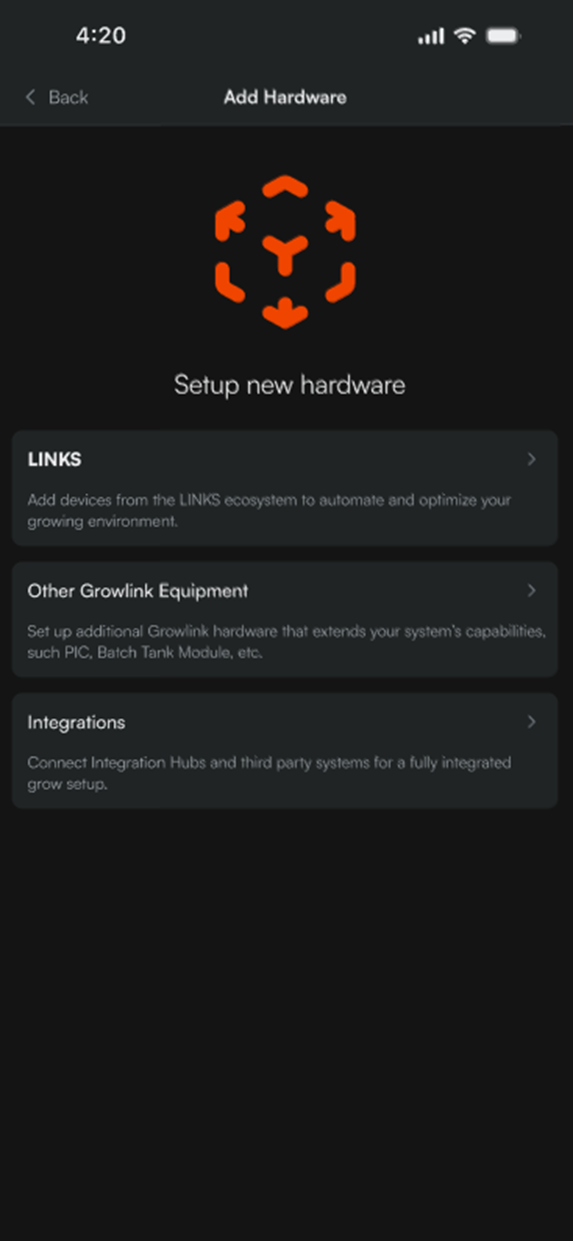
10) Select the ‘Add Devices’ option to add the controller to the specified room: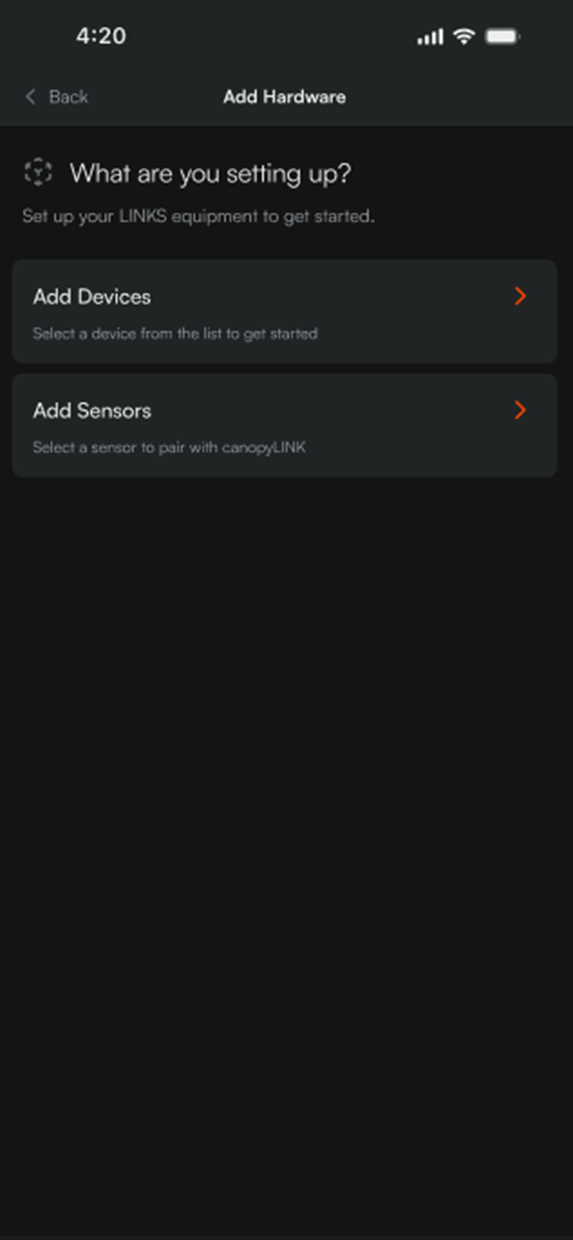
11) Select the ‘4 channel lightLINK’ option in the following menu that populates: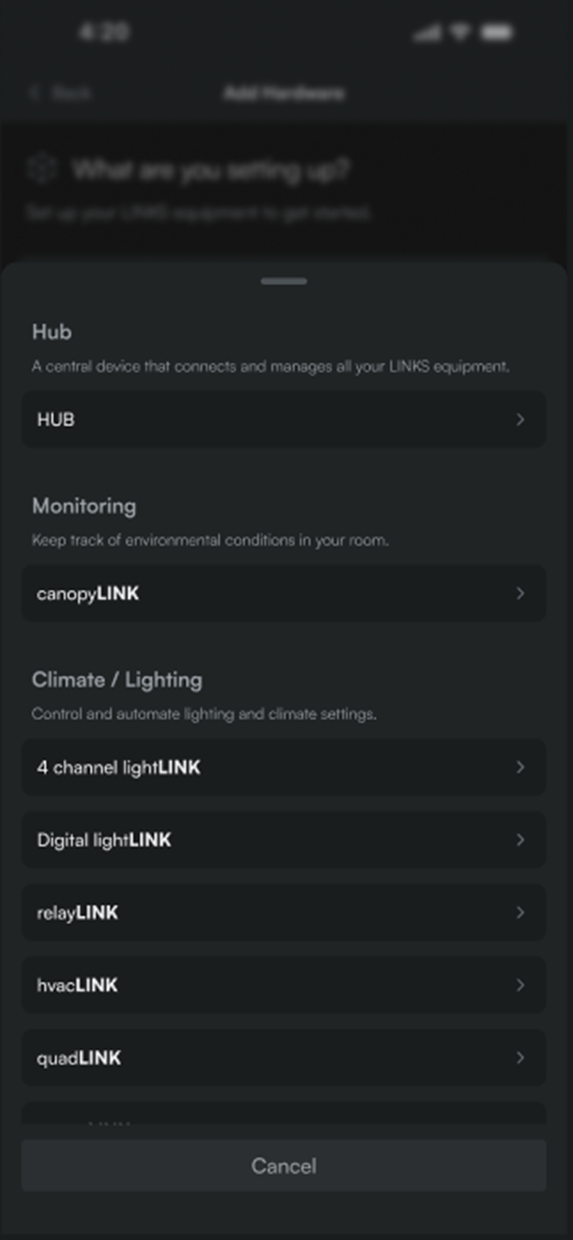
A 4ch lightLINK cannot be setup as a standalone controller and instead must be connected to a LINKS Hub with a registered canopyLINK and climaLINK sensor connected to it. This is to ensure the 4ch lightLINK and the LINKS Hub are able to determine the temperature in the room in order to activate its related high temperature lighting failsafe or no data lighting failsafe to protect the plants within the space.
12) In the following screen, select the LINKS Hub you wish to connect the 4ch lightLINK to: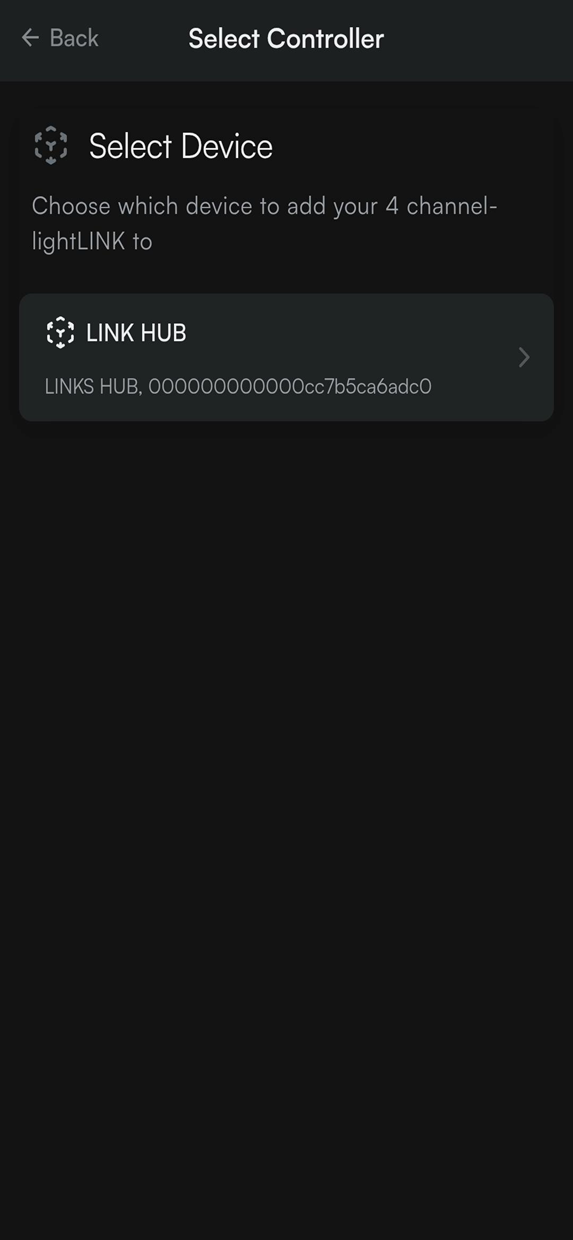
13) Connect the 4ch lightLINK to one of the Hub ports on your LINKS Hub in order for the 4ch lightLINK to be detected by your LINKS Hub.
14) Once the 4ch lightLINK has been detected, the app will populate outputs of the 4ch lightLINK, where you can then name the outputs, set the equipment types for those outputs, and register that configuration to your LINKS Hub: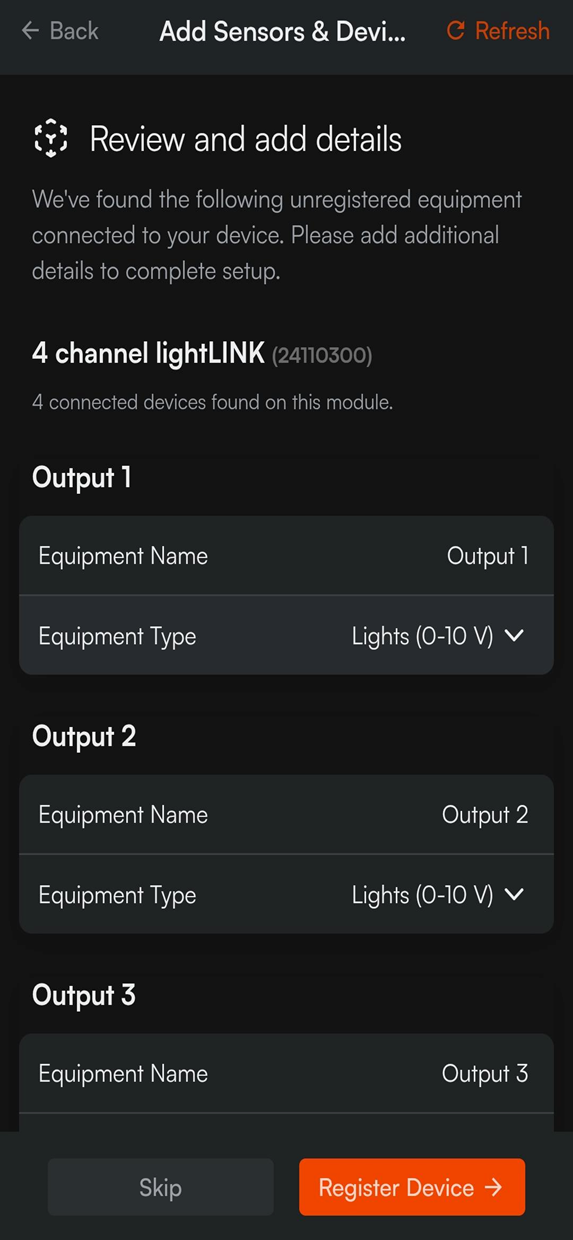
Once the outputs have been named to your liking and any required fields for the module have been designated, one can tap the ‘Register Device’ button to push that configuration to your newly configured 4ch lightLINK and paired LINKS Hub.
16) Once successfully connected and configured, the following success message will display. Tap the ‘Add Equipment to this Controller’ to add more hardware to your LINKS Hub, Tap the ‘Edit Controller Profile’ button to update the Controller Profile Settings, or tap the ‘Go to Room Dashboard’ button to view the dashboard for the newly connected controller: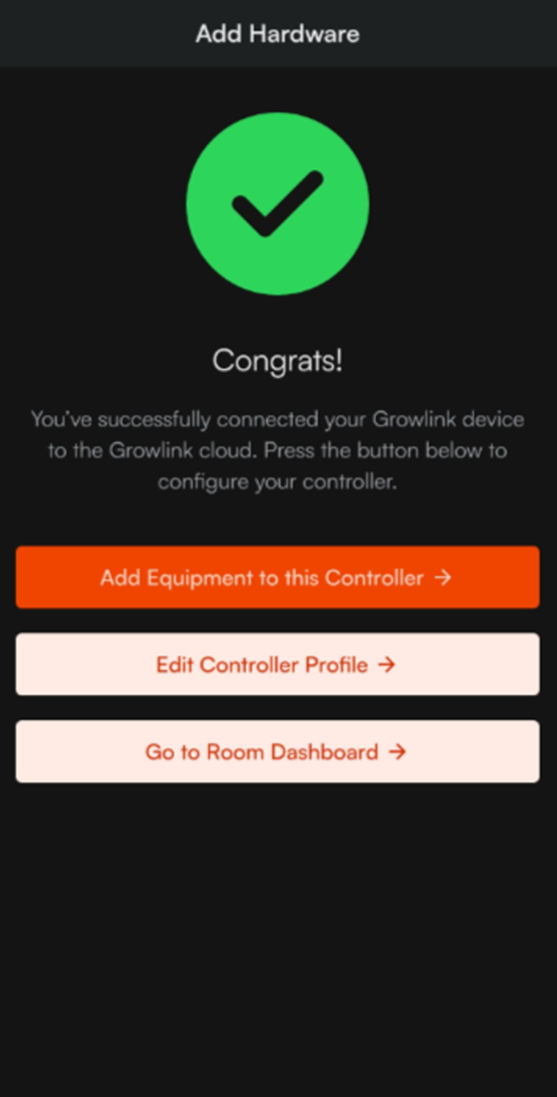
Troubleshooting
Controller not showing up on my list of devices to connect:
Check your phone or tablet and ensure Bluetooth is enabled.
Hold down the Setup button located on the controller (see image below) for approximately 12-15 seconds until there is a rapid flashing blue light. Then refresh the device list on your phone or tablet.
Unplug the unit for 10 seconds and then plug the device back in and wait for the LED lights to stop changing colors (typically 15 seconds). Then refresh the device list on your phone or tablet.
Controller didn’t connect to Wi-Fi:
If unsuccessful in the first attempt to connect the controller to the Wi-Fi network, hold down the Setup button located on the controller (see image below) for approximately 12-15 seconds until there is a rapid flashing blue light. Once rapid flashing becomes visible, immediately release the Setup button. This will put the controller into Listening Mode (Blinking Blue). Now, restart the connection process outlined in the Quick Setup Guide section above.
The Wi-Fi network being used has changed:
In the event the controller needs to re-connect to an existing or new Wi-Fi network, put the controller back into Listening Mode (see above) and follow the Controller Connection process outlined in the Quick Setup Guide section above.
Controller LED Status Light Color Codes
During device setup and operation, these are the LED light indicators:
- Solid White: Firmware Startup
- Slow Flashing Green: Wi-Fi connecting
- Fast Flashing Green: Wi-Fi waiting on IP address
- Fast Flashing Cyan: Wi-Fi connected, connecting to cloud
- Fast Breathing Green: Loading configuration and detecting probes
- Slow Breathing Green: Connected to cloud and running
- Slow Flashing Blue: Wi-Fi configuration mode
- Safe Mode: Slow breathing magenta
- Safe Mode Requested: Fast flashing magenta
- Firmware Updating: Slow flashing magenta
- Slow Flashing Blue: Wi-Fi setup mode